
The Order to Fix Your Finances in Your 30s and 40s
If you've been meaning to "sort your finances" for a while now, you're not short of options telling you what to do. Budget more. Invest earlier. Clear your debt. Use your ISA. Get a pension sorted. All true. All useful. And yet somehow, the whole thing still sits on the to-do list.
Part of what makes it hard is that nobody tells you what to do first. And in a world that currently feels anything but stable (energy prices twitching upward again, interest rate decisions coming and going, an economic forecast that changes every few weeks), the noise around money has never been louder. When everything feels urgent, the temptation is to either panic-action your way through decisions or put the whole thing off until things "calm down."
Neither tends to work particularly well.
What tends to work, and what I see consistently with clients, is having a clear sequence. Not a list of things to think about. An actual order of priority that removes the guesswork, stops you switching between half-completed tasks, and lets you move through the stages rather than spinning on the spot.
This is that sequence.
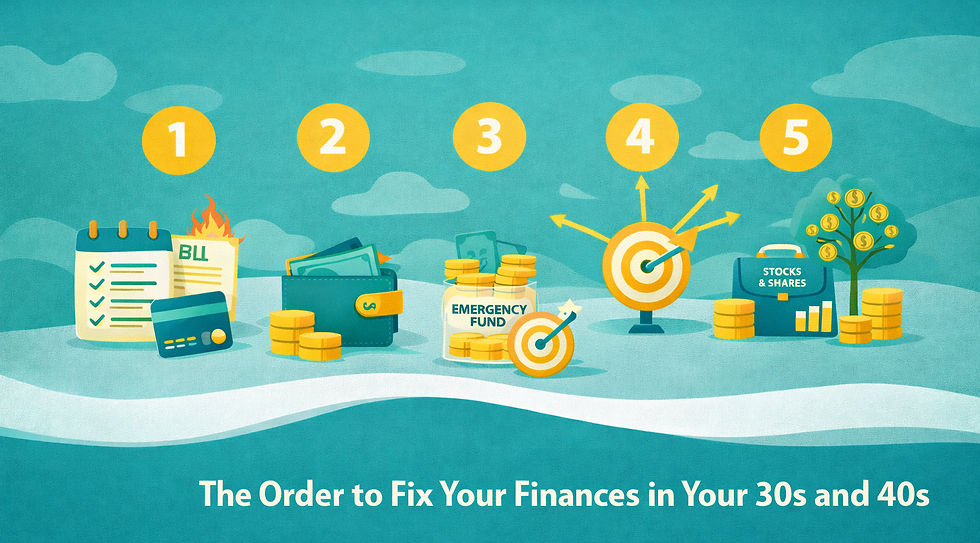
What is the right order to fix your finances? The most effective approach is to work in this sequence: address expensive debt first, then build a cashflow system, then create a structured savings approach, then clarify your goals, then begin investing. Each stage supports the next. Skipping stages tends to create problems that pull you backwards.
Why Order Matters More Than Speed

There's a temptation, especially if you're earning well and feel behind, to want to tackle everything at once. Start investing, clear the credit card, sort the pension, build the emergency fund, all in parallel.
The problem is that without a structure underneath you, most of these things fight each other. You put money into an ISA one month, then have to raid savings to cover an unexpected bill the next. You make a start on investing while still paying 24% interest on a credit card balance. You spend hours researching index funds before you even know what you're trying to build towards.
Sequence solves that. Once you know what comes before what, each decision gets simpler. And simplicity is what makes financial habits stick.
Step 1: Deal With Expensive Debt
This comes first. Not because debt is shameful or a sign of failure, but because expensive debt is the single most effective wealth-destroyer most people have access to. With average credit card interest rates at 24.65% in 2025, a balance of £1,900 costs around £468 a year in interest. That's money going entirely backwards.
Expensive debt means anything with a high interest rate: credit cards, store cards, overdraft fees, personal loans above 10% or so. If you're carrying these while simultaneously trying to save or invest, the maths is working against you. There's very little investment return that consistently beats a 20%+ interest rate.
This doesn't mean never borrow. It means recognising that clearing expensive debt is, in most cases, the highest-return financial move available to you. Every pound you put towards a 24% credit card balance is effectively a 24% return.
What this looks like in practice: List every debt with its balance and interest rate. Focus any surplus money on the most expensive debt first while maintaining minimum payments on the rest. Once that's gone, roll the freed-up payment onto the next one.
Step 2: Build a Cashflow System
Once expensive debt is under control (or at least on a clear trajectory), the next priority is understanding and organising your cashflow.
Cashflow is what most people mean when they say "I need to sort my finances." Where is the money going? Am I spending in line with what I actually care about? Do I know what's coming in and out each month, or am I reacting to whatever's in my current account?
A cashflow system doesn't have to be a detailed spreadsheet (though that can help). At its most basic, it's a way of directing money intentionally rather than spending what's left after everything has happened. What tends to work for most people is separating money by purpose: one account for bills and fixed costs, one for spending, one for saving. That way the decisions are mostly made once, in advance, rather than constantly on the fly.
This is also the point where things like standing orders, direct debits, and automatic transfers start doing the heavy lifting. A system that runs itself reduces the mental load significantly.
Step 3: Create a Savings Structure
With cashflow organised, savings become far easier to manage. The question shifts from "should I save?" to "what am I saving for, and how much does each thing need?"
The first savings priority for most people is a buffer: money set aside for unexpected costs that doesn't require going back into debt to cover them. Two thirds of UK households do not have enough savings to cover three months' worth of expenses, according to the Social Market Foundation. That means a single unexpected bill can undo months of good financial behaviour. Even £1,000 or £2,000 set aside changes that equation meaningfully.
Beyond the buffer, savings structure is about matching pots to purposes. The holiday fund. The car fund. The longer-term goal that keeps getting pushed back. Naming them and ring-fencing them removes the constant mental negotiation over whether you can "afford" something. You've already decided.
Step 4: Clarify What You're Actually Building Towards
This is the stage most financial frameworks skip, which is part of why so many people with solid incomes still feel directionless with money.
Before you optimise anything (before you decide how much to invest, or whether to overpay your mortgage, or how aggressive to be with savings) it's worth being clear about what you're working towards. Not in abstract terms ("financial freedom") but in real ones. What does the next five years look like? Is there a house purchase coming, a career change, a family decision? What's the life you're funding?
The reason this comes before investing is simple: the right approach to investing depends entirely on your timeline, your goals, and your current position. Knowing your destination changes the route.
If this kind of clarity feels elusive, as it often does especially when life is full, this is exactly where an Insight Session tends to make the most difference. Two to three hours to map out where you actually stand and what you're building towards, without the noise. It's the most useful financial conversation most people have had.
Step 5: Start Investing
Once the structure is in place (debt under control, cashflow organised, savings purpose-built, goals clarified) investing becomes far less intimidating.
The most important thing about investing is starting. According to BlackRock's December 2025 research, 62% of UK adults, around 34 million people, are not currently investing at all. Among the reasons given is the sense that the timing is wrong: markets are volatile, the world is uncertain, there's always a reason to wait.
There usually is. And waiting almost always costs more than starting imperfectly.
Only 8% of UK household wealth is held directly in equity investments, the lowest in the G7, while an estimated £430 billion sits in cash or low-interest accounts beyond emergency funds, losing value in real terms to inflation. For those in their 30s and 40s with a 20 or 30-year horizon, the gap between what cash earns and what a diversified portfolio can grow to over that time is not trivial.
This doesn't mean jumping into anything complex. ISAs, workplace pensions, and straightforward investment accounts are widely accessible. The principles are not complicated: diversify, invest regularly, minimise fees, and give it time. The harder part is the behaviour. Staying the course when markets move, not reacting to every headline.
What tends to work when starting:
Understand where investing fits in your overall picture first (i.e., stage 4 above)
Use tax-efficient wrappers where possible (pensions and ISAs exist for a reason)
Start with an amount you won't be tempted to touch
Set it up automatically so it doesn't rely on a decision every month
Review periodically, not constantly
Why This Sequence Works

"Financial stability isn't about doing everything at once. It's about doing the right things in the right order, so each step reinforces the next, and nothing you build gets undermined by something you skipped."
Each stage in this sequence addresses a specific type of financial drag. Expensive debt creates a hole in your cashflow. Disorganised cashflow means savings never stick. No savings buffer means you return to debt at the first unexpected cost. Unclear goals mean investing decisions are arbitrary. Delayed investing means the compounding clock starts later than it needs to.
Work through the stages in order and they become a self-reinforcing system rather than a set of competing demands.
Where Are You in the Sequence?
If you're reading this and realising you've been jumping between stages without finishing them, that's a very common pattern. It doesn't mean starting over. It means identifying where you actually are and picking back up from there.
Some people reading this will have the debt stage done and are stuck on cashflow. Others have great cashflow but no savings structure. Some have savings but no clarity on goals, so investing keeps getting deferred. Some are investing but have no idea whether it connects to anything in their life.
Wherever you are, the path forward is the same: clarity first, then the next step.
Let's Work Through This Together
If you're not sure exactly where you sit in this sequence, or you want to work through the specifics of your situation rather than the theory, that's what I'm here for.
The simplest place to start is a free Q&A call. No pressure, no pitch. Just a conversation about where you are and whether working together makes sense.
And if you're ready to go deeper, to map out your full financial picture, get a prioritised action plan, and leave with absolute clarity on what to focus on, an Insight Session is designed exactly for that.
You don't need a perfect salary or a clean financial history to start. You just need a starting point.
If this is the first time you've thought about money in sequence rather than as a list of things to do, you might also find these useful:
You Earn Well… So Why Doesn't It Feel Like It? - on the gap between income and financial clarity
When the World Feels Chaotic, Here's What Actually Matters With Your Money - on keeping perspective in uncertain times
Written by Vignesh Sivagnanam, The UK Money Coach. Vig helps people manage their money in alignment with their life priorities through behaviour-led, implementation-driven coaching. He works with individuals and couples across the UK who earn well but want more clarity, control, and confidence with their finances.


Comments